
Main Text
Paraphrased from Reginald’s account.
Précis
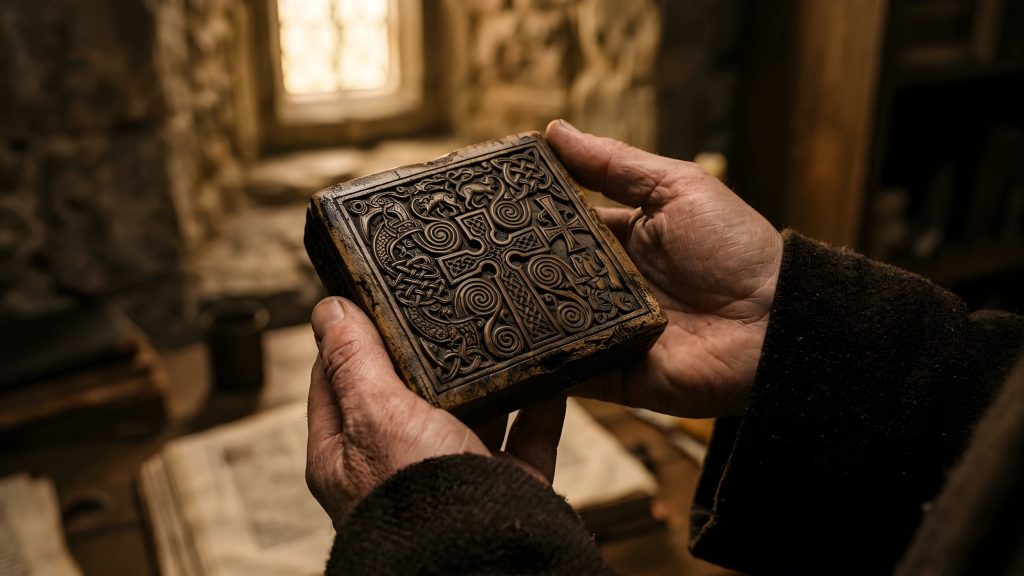
Just before one Easter in the twelfth century, Benedict, the sacristan at Durham Cathedral, displayed precious items honouring the patron saint, Cuthbert of Lindisfarne. From this, a thief stole an ivory box and tucked it under his shirt; but immediately he found himself unable to see or find his way, or even move the box to a better hiding place.
The thief was discovered sitting in the middle of the church by monk Reginald, who raised the alarm. The ivory box was spotted beneath the thief’s shirt, but for some reason neither he nor the monks could get it out. Benedict was only person who could, which Reginald regarded as a token of the saint’s appreciation for Benedict’s care.
Shortly before one Easter (so Reginald tells us) in bishop Hugh’s day, Benedict the sacristan decorated the church at Durham Priory with a selection of the public’s offerings to St Cuthbert. All around the shrine and altar many beautiful pieces were displayed.
For one poor man, the temptation was irresistible. As the shadows fell after Evensong, he slipped into a corner and waited; and when all was quiet, he crept out through the dappled shades of dusk towards the altar. High on one side was a little ivory box, and the thief clambered onto the bishop’s throne, took down the box, and stuffed it beneath his shirt.
But as he began to climb down, an ever-thickening fog settled upon his sight. Soon he was quite blind. He had eyes, but Cuthbert had veiled them; he had feet, but they went whither Cuthbert directed them. Groping about, he reached what he thought was his former hiding place, where he tried to tuck the ivory box discreetly into his breeches or boots; but the incriminating trophy seemed to adhere to his shirt. In rising panic he tried to shake it out, and was still fumbling stupidly when he heard footsteps.
The footsteps came nearer and nearer, until the thief felt a heavy body stumble into him. It was Reginald, carrying bundles of candles. Reginald demanded with some asperity to know who was there, and why he was crouching in the middle of the altar steps — the most public spot in the church. Impatient of the thief’s excuses, Reginald hustled him through a door on the north side and left him beside the altar of St Oswald.
At first glance, Reginald thought nothing had been taken, but then he missed the little ivory box. “I have been trying to get it out of my shirt” the wretched fellow complained, when accused of the theft, “but I can’t”. Reginald and the other monks lent willing hands, but the box eluded their grasp in the most uncanny way. Only when Benedict reached beneath the shirt did the little box meekly allow itself to be drawn out.
All this (Reginald ended) shows the compassion of St Cuthbert, who made sure that Benedict did not lose any of the precious things he had so lovingly displayed in the saint’s honour, and also arranged it so that when one almost went missing, Benedict was the man to recover it.