
Main Text
In 1554, Robert Tomson, of Andover, sailed from Bristol to Cadiz to make his fortune. He went to Seville, where he found an Englishman, John Field, who had been settled there for twenty years, with his wife and family. Tomson learned Spanish and looked about him. Seeing the produce which came from the West Indies, “he did determine with himself to seek means to pass over to that rich country, whence such a great quantity of rich commodity came”. Field was caught by his enthusiasm, and set off with his wife and family to Mexico. On the journey they suffered shipwreck, but were saved by another vessel. They lost all their goods, and landed “naked and distressed” at San Juan de Ulloa.
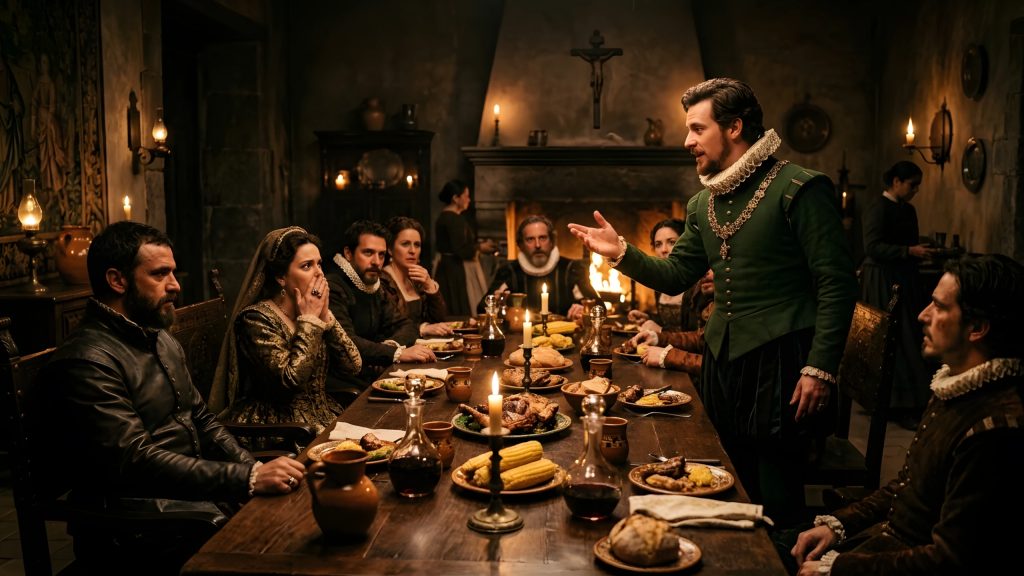
There, however, Field met an old acquaintance in Spain, who generously supplied their needs, and gave them means to pursue their journey to Mexico. On the way Field and most of his family died of fever bred by the pestilent country. Tomson was ill for six months, but found even there a Scotsman who had been settled for twenty years, and by his recommendation found employment, in which he prospered for a year and a half. Then he fell into a theological discussion one day at dinner, and conducted it with all an Englishman’s self-sufficiency. “It is enough to be an Englishman to know all about that and more,” was the remark, he tells us, of a bystander.
He was delated to the Inquisition, was condemned to do three years’ penance, and was sent back as a prisoner to Seville. On his release, he took the post of cashier in the office of an English merchant, and then chanced to meet a lady who had sailed from Mexico with her father who died on the voyage. Finding her unprotected, and the possessor of some £25,000, he chivalrously married her, and recounts the fact “to show the goodness of God to all them that trust Him”.
In this story, we have all the characteristics of the modern Englishman — an adventurous spirit, practical sagacity, a resolve to succeed, a willingness to seek his fortune in any way, courage to face dangers, cheerfulness under disaster, perseverance in the sphere which he has chosen. Moreover we find him, even in those early days, personally acceptable in the land where he goes, valued for his capacity and probity, treated with kindness and consideration, exciting no animosity, and intermarrying with the folk amongst whom he lives. Yet, all the while, he remains every inch an Englishman, does not change his ideas or modify his opinions, cannot hold his tongue when he is challenged, but is ready to put everybody right. Finally, because of these very qualities, he inspires such confidence in his general uprightness that a defenceless girl feels secure under his protection and commits herself and her possessions to his care.




This Overture includes a number of traditional folksongs. They include: