
Main Text
Précis
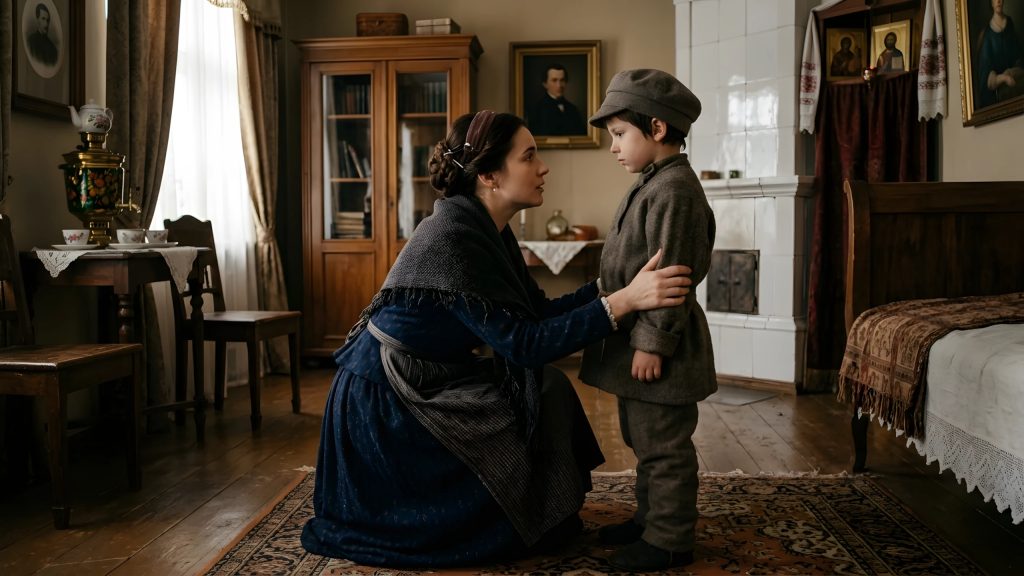
In 1878, a mother asked Fyodor Dostoevsky for advice on bringing up children with a sense of right and wrong. He told her that all any parent could do was to set a good example. Even if she occasionally slipped up, her son would remember her goodness and forget her failings, and his character would take after hers.
Dostoevsky urged the anxious mother to raise her son in the Russian Church, as a fine Christian man is far superior to a so-called success. A boy from a home environment such as he had described would never question his duty to his parents, and if bad company misled him, his mother’s smile alone would bring him back.
Petersburg,
March 27, 1878.
Every human being, who can grasp the truth at all, feels in his conscience what is good and what is evil. Be good, and let your child realize that you are good; in that way you will wholly fulfil your duty towards your child, for you will thus give him the immediate conviction that people ought to be good. Believe me, it is so. Your child will then cherish your memory all his life with great reverence, it may be often with deep emotion as well.
And even if you do something wrong, that is, something frivolous, morbid, or even absurd, your child will sooner or later forget all about it, and remember only the good things. Mark me: in general, you can do no more than this for your child. And it is really more than enough. The memory of our parents’ good qualities, of their love of truth, their rectitude, their goodness of heart, of their freedom from false shame and their constant reluctance to deceive, all this will sooner or later make a new creature of your child: believe me. And do not think that this is a small thing. When we graft a tiny twig on a great tree, we alter all the fruits of the tree thereby.
Your child is now eight years old; make him acquainted with the Gospel, teach him to believe in God, and that in the most orthodox fashion. This is a sine qua non; otherwise you can’t make a fine human being out of your child, but at best a sufferer, and at worst — a careless lethargic ‘success’, which is a still more deplorable fate. You will never find anything better than the Saviour anywhere, believe me.
Suppose now that your child at sixteen or seventeen (after some intercourse with corrupted school-friends) comes to you or to its father, and puts this question: “Why am I to love you, and why do you represent it as my duty?” Believe me: no sort of questions or knowledge will help you then; you won’t be able to give any answer. Therefore it is that you must try to act so that it will never once occur to your child to come to you with that question. But that will be possible only if your child is attached to you by such love as would prevent such a question from ever coming into its head; true, that at school such views may be for a while your child’s, but you will find it easy to separate the false from the true. And even if you should really have to listen to that question, you will be able to answer with just a smile, and quietly go on doing well.