Main Text
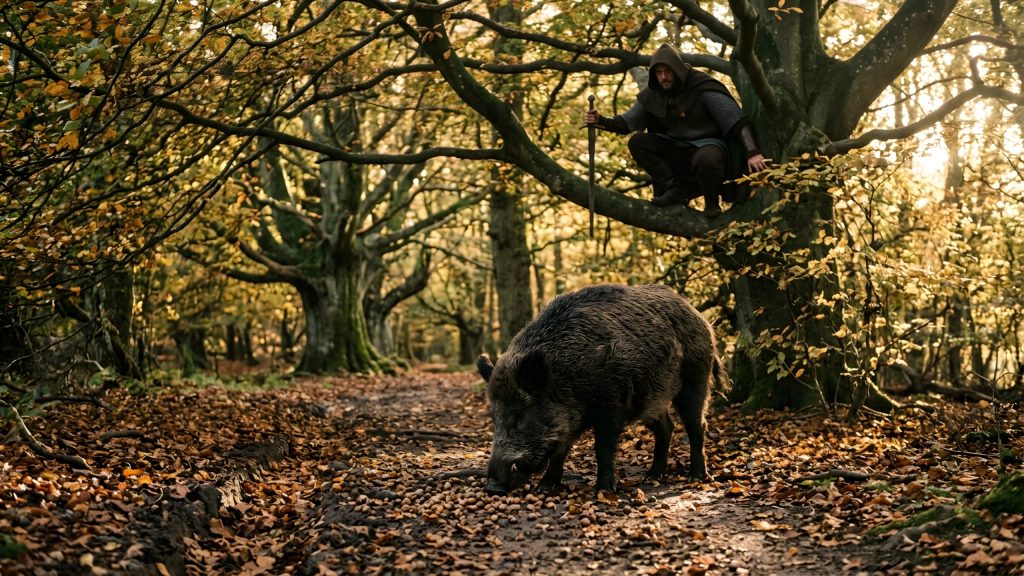
THE estates around Auckland Castle, seat of the Bishops of Durham, were troubled by a wild boar, so much so that the Bishop and even the King had each put up a princely reward for his head.
So Richard Pollard, of respectable but impoverished family, climbed a beech tree overhanging the animal’s regular paths, shook down a quantity of beechnuts, and waited. As expected, the boar came on them and gobbled them up, allowing Pollard to slip down from his tree and behead him. Pollard sliced off a little tongue, pocketed it for later, and settled down for a nap.
When he awoke, the trophy head was gone.
The Bishop, who was at dinner, graciously declared the tongue token enough without the head, and promised as much land from his estate as Pollard could ride around before the meal was over.
As his lordship was finishing his wine, Pollard reappeared to say that he had ridden round Auckland Castle — and looked expectantly at the paling bishop.
The Bishop was a man of honour, and redeemed his Castle by asking Pollard to accept instead a spread of best-quality farmland, the only stipulation being that the Pollards would present each new bishop with a handsome falchion in token of the right to the land (a ceremony practised until 1856).
Meanwhile the lord of another ancient family, the Northumberland Mitfords, was exhibiting Pollard’s hard-won trophy to the King as his own. On his way to the capital on business, he had seen the head lying next to the sleeping Pollard, speared it, and ridden on to claim his prize. When this news reached Pollard, he hurried after to present his sliver of tongue, but His Majesty was now weary of the matter.
The Pollards of Pollard Hall proudly included a silver falchion, token of their right, in their family’s coat of arms. The Mitfords’ arms, on the other hand, showed a boar’s head pierced by a spike, and the motto, ‘God careth for us’.