Main Text
Précis
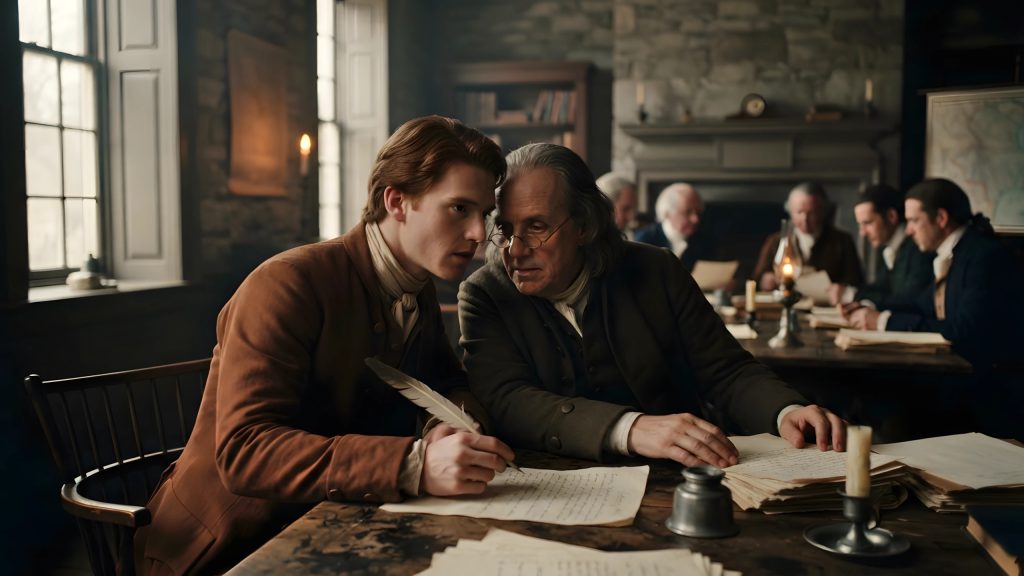
Thomas Jefferson recalled the irritation he felt while listening to members of Congress criticising the draft of the US Declaration of Independence. He recalled too how Benjamin Franklin had noticed his unease, and comforted him with an anecdote of his own experience of critics. Franklin had been commissioned to create a shop sign for a hatter; but eager voices had found fault with every word of the hatter’s copy — quite literally, for by the time they had finished, his ten-word sign had been reduced to the hatter’s name and a small picture of a hat.
When theWhen the Declaration of Independence was under the consideration of Congress there were two or three unlucky expressions in it which gave offense to some members. The words ‘Scotch and other foreign auxiliaries’ excited the ire of a gentleman or two of that country. Severe strictures on the conduct of the British King in negativing our repeated repeals of the law which permitted the importation of slaves were disapproved by some Southern gentlemen whose reflections were not yet matured to the full abhorrence of that traffic. Although the offensive expressions were immediately yielded, these gentlemen continued their depredations on other parts of the instrument.
I was sitting by Dr Franklin, who perceived that I was not insensible to these mutilations. “I have made it a rule,” said he, “when ever in my power, to avoid becoming the draughtsman of papers to be reviewed by a public body. I took my lesson from an incident which I will relate to you. When I was a journeyman printer, one of my companions, an apprentice hatter, having served out his time, was about to open shop for himself. His first concern was to have a handsome signboard, with a proper inscription. He composed it in these words, ‘John Thompson, Hatter, makes and sells hats for ready money,’ with the figure of a hat subjoined; but he thought he would submit it to his friends for their amendments. The first he showed it to thought the word ‘Hatter’ tautologous, because followed by the words ‘makes hats,’ which showed he was a hatter. It was struck out. The next observed that the word ‘makes’ might as well be omitted, because his customers would not care who made the hats. If good and to their mind, they would buy, by whomsoever made. He struck it out. A third said he thought the words ‘for ready money’ were useless, as it was not the custom of the place to sell on credit; every one who purchased expected to pay. They were parted with, and the inscription now stood, ‘John Thompson sells hats.’ ‘Sells hats?’ says his next friend. ‘Why, nobody will expect you to give them away; what then is the use of that word?’ It was stricken out, and ‘hats’ followed it, the rather as there was one painted on the board. So the inscription was reduced ultimately to ‘John Thompson,’ with the figure of a hat subjoined.”