Main Text

English critic Thomas Carlyle was a famous proponent of the ‘Great Men’ theory of history, which holds that world-changing events are moved by bold, powerful, iron-willed men of vision, and that ordinary folk long to be mastered by them. Russian novelist Leo Tolstoy was not of this brotherhood. In his classic War and Peace (serialized 1865-67), he reminded us that wars gain their own horrible momentum, and those who start them are rarely in control of them.
Précis
In ‘War and Peace’, Leo Tolstoy reflected on the responsibility that Napoleon Bonaparte should bear for the wretched and bloody battle at Borodino, during his assault on Moscow. Those who said that Napoleon’s genius was somewhat diminished by a cold, he said, inadvertently showed how little real control over his destiny Napoleon had; and just as his cold might be the responsibility of a careless valet, so responsibility for the course of the battle must be put down to his soldiers, who willingly consented to fight in it.

Many historians assert that the French failed at Borodino because Napoleon had a cold in his head;⁠ that if he had not had a cold the orders given by him before and during the battle would have been even more remarkable for their genius, and Russia would have been lost and the face of the world would have been changed. To historians, who can maintain that Russia was transformed at the will of one man — Peter the Great⁠ — and that France, from a republic, became an empire, and that the French army marched into Russia at the will of one man — Napoleon — the conclusion that Russia has remained a power because Napoleon had a bad cold on the 26th of August may seem indisputable and convincing. Had it depended on Napoleon’s will to fight, or not to fight, at Borodino, or had it depended on his will whether he gave this order or that, it is evident that a cold, affecting the manifestation of his will, might be the saving of Russia, and consequently the valet, who forgot to put on Napoleon’s waterproof boots on the 24th,⁠ would be the saviour of Russia.⁠ […]

At the battle of Borodino Napoleon did not fire at any one, nor kill any one. All that was done by his soldiers. Therefore it was not he who killed those men. The soldiers of the French army went out to slay their fellow-men at Borodino, not owing to Napoleon’s commands, but through their own desire to do so. The whole army — French, Italians, Germans, Poles — hungry, ragged, and exhausted by the march, felt at the sight of an army, barring their way to Moscow: the wine is drawn, it must be drunk.⁠ Had Napoleon forbidden them at that point to fight the Russians, they would have killed him, and have proceeded to fight the Russians, because it was inevitable for them.

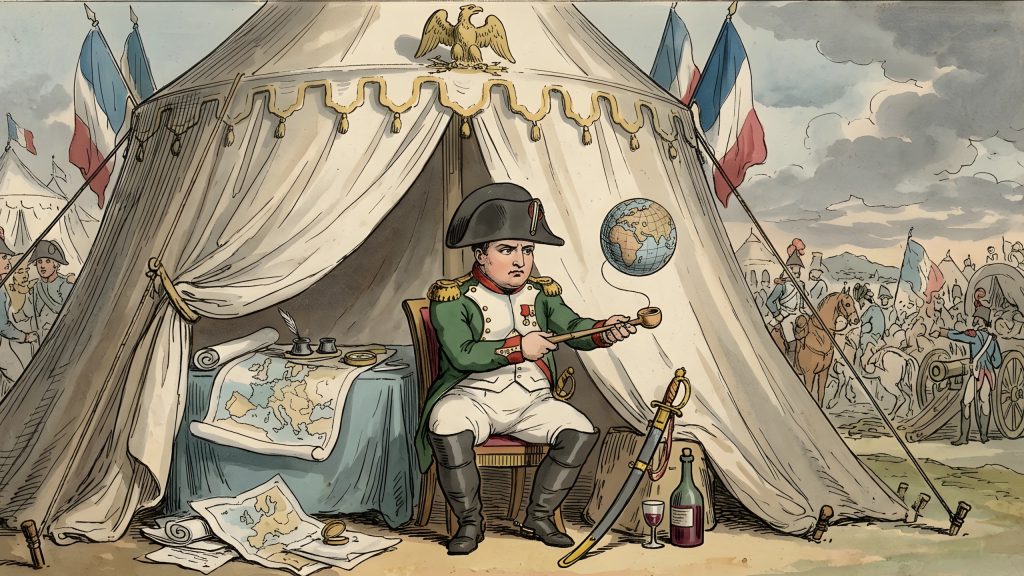
When they heard Napoleon’s proclamation offering them as consolation for maiming and death the reminder that posterity would say that they had been at the battle before Moscow, they shouted, Vive l’Empereur, just as they shouted Vive l’Empereur at the sight of the picture of the little boy playing cup and ball with the earth,⁠ and just as they shouted Vive l’Empereur at every absurdity that was said. There was nothing left for them to do but to shout Vive l’Empereur! and to fight so as to get food and rest as conquerors in Moscow. Therefore it was not owing to Napoleon’s commands that they killed their fellow-men.

And it was not Napoleon who ordained the course of the battle, because none of his instructions were put into execution, and he knew nothing of what was passing before him. Therefore the manner in which these men slaughtered one another did not depend on Napoleon’s will, but proceeded independently of him, from the wills of the hundreds of thousands of men who took part in the affair. It only seemed to Napoleon that all this was due to his will. And therefore the question whether Napoleon had or had not a cold in his head is of no more interest to history than the cold of the lowest soldier of the commissariat.


Footnotes

Footnote

Battle of Borodino

The Battle of Borodino took place some seventy miles west of Moscow in 1812. Napoleon did win the day and gain entry to Moscow, but for some reason he did not pursue his advantage as ruthlessly as on similar occasions, and was soon afterwards forced into a humiliating retreat which led to his (temporary) abdication as French Emperor on April 6th, 1814.

Footnote

Peter the Great

Peter the Great ruled Russia from 1682 to 1725, as sole ruler from 1696, and as Emperor from 1721. He is widely held to have turned Russia, which he inherited as a mediaeval state at the European margins, into one of the Great Powers of his age. Tolstoy, of course, refused to give Peter sole credit.

Footnote

Twenty-fourth of August

The date of the battle itself was August 26th, 1812, ‘Old Style’ (i.e. on the Julian Calendar in use in Russia until 1918, and in England until 1752). That same day was September 7th ‘New Style’. Tolstoy gave Napoleon’s alleged cold forty-eight hours to incubate. His point is that the more you cling to Carlyle’s “Great Men” theory, the more you are plunged into the insoluble paradox that insignificant people and things thereby affect the course of history, because they affect the Great Men.

Footnote

The saviour of Russia

One might mistakenly infer from this that Russia won the Battle of Borodino, whereas it was a tactical victory for France. Nevertheless, it was indeed a strategic error, because Napoleon’s hungry, ragged, and exhausted men were unable to hold on to Moscow, and suffered further losses that were ultimately disastrous for the entire campaign. Tolstoy’s point, however, is that the more you cling to Carlyle’s “Great Men” theory, the more you are plunged into the insoluble paradox that insignificant people and things thereby affect the course of history, because they affect the Great Men.

Footnote

It must be drunk

A French saying, which Tolstoy left in its original language but Constance Garnett translated. It means that once the cork has been pulled (drawn), the wine might as well be drunk up or it will spoil. Tolstoy is saying that the soldiers in Napoleon’s army would have fought at Borodino whether he wanted them to or not, because it seemed to them like the shortest path out of their misery.

Footnote

Cup and ball

Tolstoy is referring to a scene in his novel that had taken place on the eve of the famous battle. Napoleon, in his encampment at Valuevo (now the site of a gracious Sanatorium, some sixteen miles southwest of Moscow city centre), received dignitaries from Paris and Madrid. M de Beausset, prefect the Emperor’s palace, presented Napoleon with an image of the Emperor’s infant son, who was shown as an angelic, curly-headed child playing cup-and-ball, with the ball shown as a terrestrial globe.

Author Details

Leo Tolstoy
Count Leo Nikolayevich Tolstoy
Source
From
War and Peace (serialised 1865-67, book form 1869), tr. Constance Garnett (1900)

Get in touch with me through my profile on
Buy Me a Coffee

See Also

Unlike Tolstoy, his English contemporary Lord Acton thought that Great Men bear grave responsibility for the misery they inflict, and should be made to feel it, even if it is only in the pages of history books. See The Verdict of History.