Main Text
Précis
In Charles Dickens’s novel ‘Martin Chuzzlewit’, Sarah Gamp has called on the undertaker Mr Mould and his wife. She has been invited to share her news, and obliges freely, taking care to comment flatteringly on Mrs Mould’s youthful looks, and frequently mentioning conversations with her friend Mrs Harris. Mrs Harris was always full of praise for Sarah Gamp’s wisdom and good nature; but none of those who knew Mrs Gamp had ever met this loyal friend, and most guessed that she was a figment of Mrs Gamp’s imagination.
“Now Mrs Gamp, what’s your news?”
The lady in question was by this time in the doorway, curtseying to Mrs Mould. At the same moment a peculiar fragrance was borne upon the breeze, as if a passing fairy had hiccoughed, and had previously been to a wine-vaults.
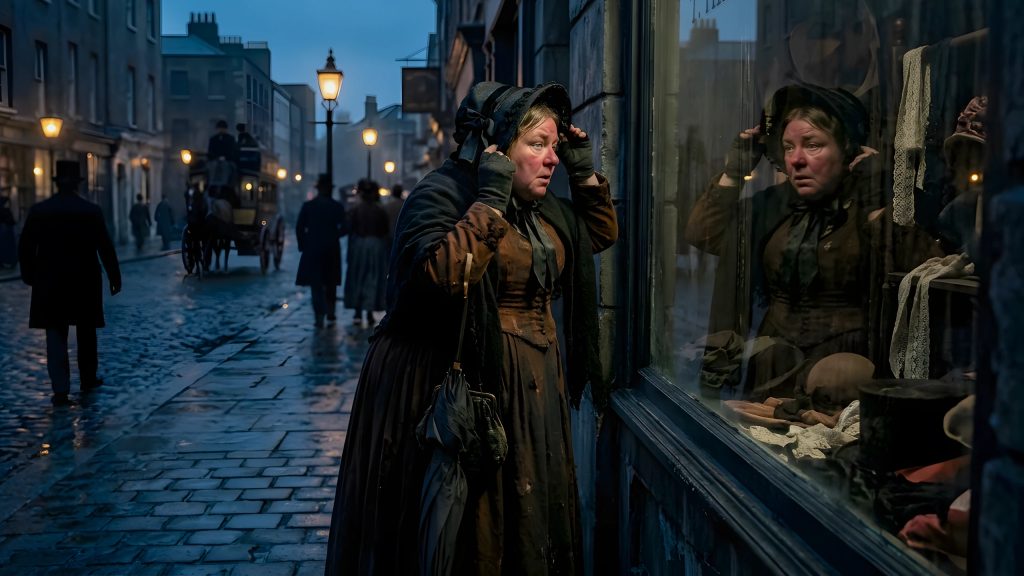
Mrs Gamp made no response to Mr Mould, but curtseyed to Mrs Mould again, and held up her hands and eyes, as in a devout thanksgiving that she looked so well. She was neatly, but not gaudily attired, in the weeds she had worn when Mr Pecksniff had the pleasure of making her acquaintance; and was perhaps the turning of a scale more snuffy.
“There are some happy creeturs,” Mrs Gamp observed, “as time runs back’ards with, and you are one, Mrs Mould; not that he need do nothing except use you in his most owldacious way for years to come, I’m sure; for young you are and will be. I says to Mrs Harris,” Mrs Gamp continued, “only t’other day; the last Monday evening fortnight as ever dawned upon this Piljian’s Projiss of a mortal wale; I says to Mrs Harris when she says to me, “Years and our trials, Mrs Gamp, sets marks upon us all.’ — ‘Say not the words, Mrs Harris, if you and me is to be continual friends, for sech is not the case.’
“‘Mrs Mould,’ I says, making so free, I will confess, as use the name,” (she curtseyed here), “‘is one of them that goes agen the obserwation straight; and never, Mrs Harris, whilst I’ve a drop of breath to draw, will I set by, and not stand up, don’t think it.’—‘I ast your pardon, ma’am,’ says Mrs Harris, ‘and I humbly grant your grace; for if ever a woman lived as would see her feller creeturs into fits to serve her friends, well do I know that woman’s name is Sairey Gamp’.”
At this point she was fain to stop for breath; and advantage may be taken of the circumstance, to state that a fearful mystery surrounded this lady of the name of Harris, whom no one in the circle of Mrs Gamp’s acquaintance had ever seen; neither did any human being know her place of residence, though Mrs Gamp appeared on her own showing to be in constant communication with her. There were conflicting rumours on the subject; but the prevalent opinion was that she was a phantom of Mrs Gamp’s brain — as Messrs. Doe and Roe are fictions of the law — created for the express purpose of holding visionary dialogues with her on all manner of subjects, and invariably winding up with a compliment to the excellence of her nature.