Read this little historical tidbit, and see if you can guess what common English expression it gave rise to.
ByClay Lane
Main Text
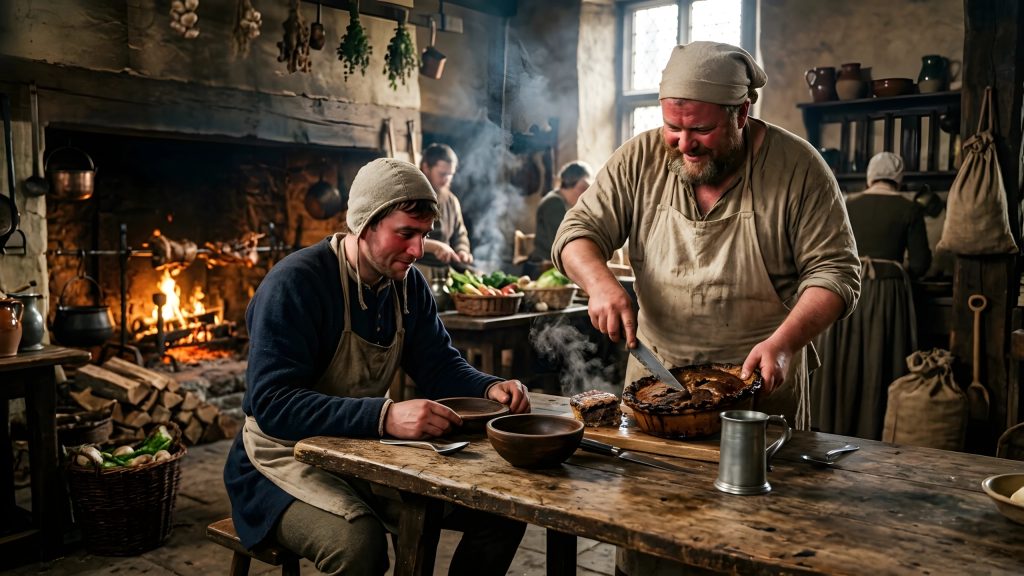
In the Middle AgesIN the Middle Ages, it was the custom in fine houses to hunt deer. The reward for success in the field was a dinner of roast venison; but not all parts of the carcass were prized equally, and the heart, liver, kidneys, and other entrails ended up in pies on the plates of servants in the kitchens. In those far-off days, French was still the language of refinement, and the disdainful Quality called these parts the nombles; but over in the kitchens the grateful ordinary Englishman knew them as the umbles.
No doubt amid much raillery, the umbles also ended up on the plate of any red-faced nobleman who had not distinguished himself during the chase — whatever his boasts in the early morning, he had not done anything to deserve a share in the prize. Over time, ‘eating nombles pie’ turned into ‘eating humble pie’, that is, making a public and shameful admission of error or failure. The Americans, in the same situations, speak of ‘eating crow’.
Think and Speak
From a ’Fifties Classroom
01
Expressions
based on the passage above
Use ‘eat humble pie’ in a single sentence. Be sure to include some indication who and why.
For Example
We must, I suppose, eat humble pie after the things you said to him, Aunt Clare.
Hugh Walpole, The Wooden Horse (1909)
The ‘why’ is Aunt Clare’s earlier remarks, and the ‘who’ is her family.
Clay Lane is based on textbooks written over
seventy years ago, to help us speak with conviction
and courage and not just reproduce the opinions of
others. My word games are intended for
adults who are free from examinations, and can settle
down to the task of developing their talents or of
making good the gaps in their command of English.
There is no examiner here. Take time to observe, to
think, and to use your imagination.
Have something to
say: say it carefully and feelingly. Go ahead.