Main Text
Précis
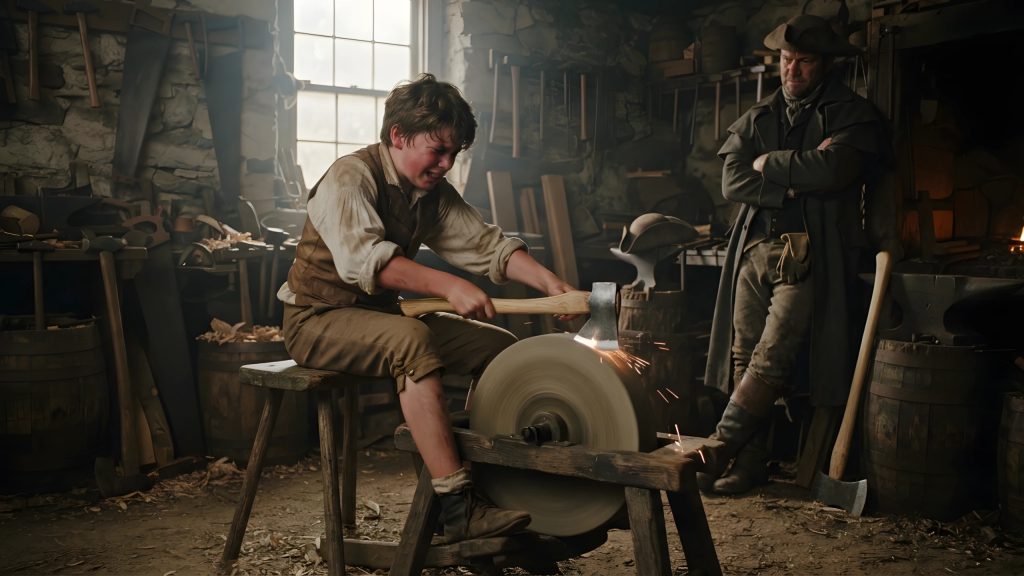
Charles Miner recalled how, when he was a child, a man had come to his home and asked for the use of the family’s grindstone. Eager to oblige so courteous and flattering a visitor, young Charles had shown him where the grindstone stood, and fetched some hot water. He even agreed to turn the stone.
Charles turned the stone until hands blistered, and he was late for school. At last the axe was sharp, and his visitor, abusing him soundly, snatched it up and left without even a thankyou. Now when Miner sees a shopkeeper flattering his customers, or a gallant flattering a girl, he thinks ‘he has an axe to grind’.
When I was a little boy, Messrs Printers, I remember one cold winter’s morning, I was accosted by a smiling man, with an ax on his shoulder, — “My pretty boy,” said he, “has your father a grindstone?” “Yes, sir,” said I.
“You are a fine little fellow,” said he, “will you let me grind my ax on it?” Pleased with his compliment of “fine little fellow” — “O, yes, sir,” — I answered, “it is down in the shop.”
“And will you my man,” said he, patting me on the head, “get a little hot water?”
How could I refuse? I ran and soon brought a kettle full.
“How old are you, and what’s your name,” continued he without waiting for a reply. “I am sure you are one of the finest lads that I have ever seen, will you just turn a few minutes for me?”
Tickled with the flattery like a little fool I went to work, and bitterly did I rue the day. It was a new ax — and I toiled and tugged, till I was almost tired to death. The school bell rung, and I could not get away, — my hands were blistered, and it was not half ground.
At length, however, the ax was sharpened, and the man turned to me, with “Now, you little rascal, you’ve played the truant, — scud to school, or you’ll rue it.” Alas, thought I, it was hard enough to turn grindstone this cold day, but now to be called “little rascal” was too much. It sunk deep in my mind, and often have I thought of it since.
When I see a Merchant, over polite to his customers, begging them to taste a little brandy, and throwing half his goods on the counter — thinks I, that man has an ax to grind.
When I have seen a man of doubtful character, patting a girl on the cheek, praising her sparkling eye and ruby lip, and giving her a sly squeeze, — Beware my girl, tho’t I, or you will find to your sorrow, that you have been turning grindstone for a villain.
When I see a man flattering the people, making great professions of attachment to liberty, who is in private life a tyrant, Methinks, look out good people, that fellow would set you to turning grindstone.