Main Text
Précis
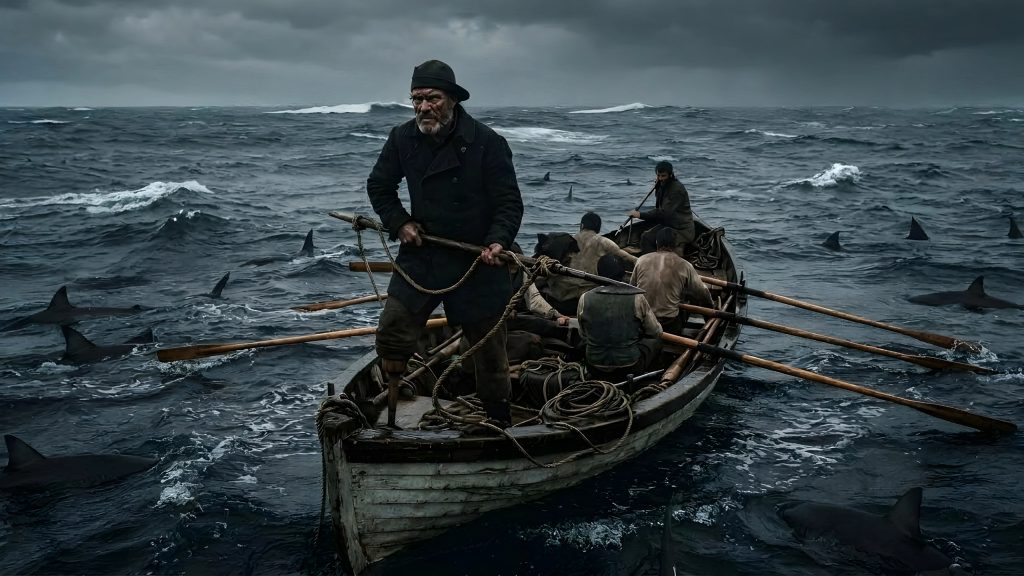
Herman Melville’s Moby Dick (1851) reaches its climax as the great white whale rams Ahab’s ship, leaving the captain exposed in his little whaling-boat. Ahab regrets that he cannot go down with his ship as convention demands, but in his mental exaltation he sees everything coming together to fulfil a prophecy of his own heroic death.
Seizing his harpoon, Ahab cries out that his whole life has been leading to this supreme moment of tragedy and triumph. Then, declaring defiance and everlasting hatred, he looses his weapon and the point strikes home — but as the whale dives, the trailing rope snags. In freeing it Ahab is caught in a loop, and dragged beneath the waves.
Retribution, swift vengeance, eternal malice were in his whole aspect, and spite of all that mortal man could do, the solid white buttress of his forehead smote the ship’s starboard bow, till men and timbers reeled. Some fell flat upon their faces. Like dislodged trucks, the heads of the harpooners aloft shook on their bull-like necks. Through the breach, they heard the waters pour, as mountain torrents down a flume.
“The ship! The hearse! — the second hearse!” cried Ahab from the boat; “its wood could only be American!”
Diving beneath the settling ship, the whale ran quivering along its keel but turning under water, swiftly shot to the surface again, far off the other bow, but within a few yards of Ahab’s boat, where, for a time, he lay quiescent.
“I turn my body from the sun. What ho, Tashtego! let me hear thy hammer. Oh! ye three unsurrendered spires of mine; thou uncracked keel; and only god-bullied hull; thou firm deck, and haughty helm, and Pole-pointed prow, — death-glorious ship! must ye then perish, and without me? Am I cut off from the last fond pride of meanest shipwrecked captains?
“Oh, lonely death on lonely life! Oh, now I feel my topmost greatness lies in my topmost grief. Ho, ho! from all your furthest bounds, pour ye now in, ye bold billows of my whole foregone life, and top this one piled comber of my death! Towards thee I roll, thou all-destroying but unconquering whale; to the last I grapple with thee; from hell’s heart I stab at thee; for hate’s sake I spit my last breath at thee. Sink all coffins and all hearses to one common pool! and since neither can be mine let me then tow to pieces, while still chasing thee, though tied to thee, thou damned whale! Thus, I give up the spear!”
The harpoon was darted; the stricken whale flew forward; with igniting velocity the line ran through the groove; — ran foul. Ahab stooped to clear it; he did clear; but the flying turn caught him round the neck, and voicelessly as Turkish mutes bowstring their victim, he was shot out of the boat, ere the crew knew he was gone. Next instant, the heavy eyesplice in the rope’s final end flew out of the stark-empty tub, knocked down an oarsman, and smiting the sea, disappeared in its depths.