John Doran gives his explanation for a common expression.
ByJohn Doran1807-1878
John Doran1807-1878
John Doran (1807–1878) was an English journalist and professional writer of Irish parentage, who for a time edited The Athenaeum, a magazine that ran from 1828 to 1921. His light and witty articles ranged widely over social history and customs, such as knightly chivalry, court jesters, food and dining habits, but he was a serious scholar, who edited Horace Walpole’s Journal of the Reign of George III, and compiled studies of the history of London and the royal House of Hanover.
Main Text
The following account of the origins of the phrase ‘scrape an acquaintance’ was provided by journalist John Doran for Gentleman’s Magazine in March 1853. It appeared as part of an article on the Roman Emperor Hadrian, who ruled from 117 to 138, and who was responsible for the monumental wall that marked the Empire’s most northerly border, stretching from Newcastle to Carlisle. It would be best to treat Doran’s tale as a fable; but it’s a very good fable.
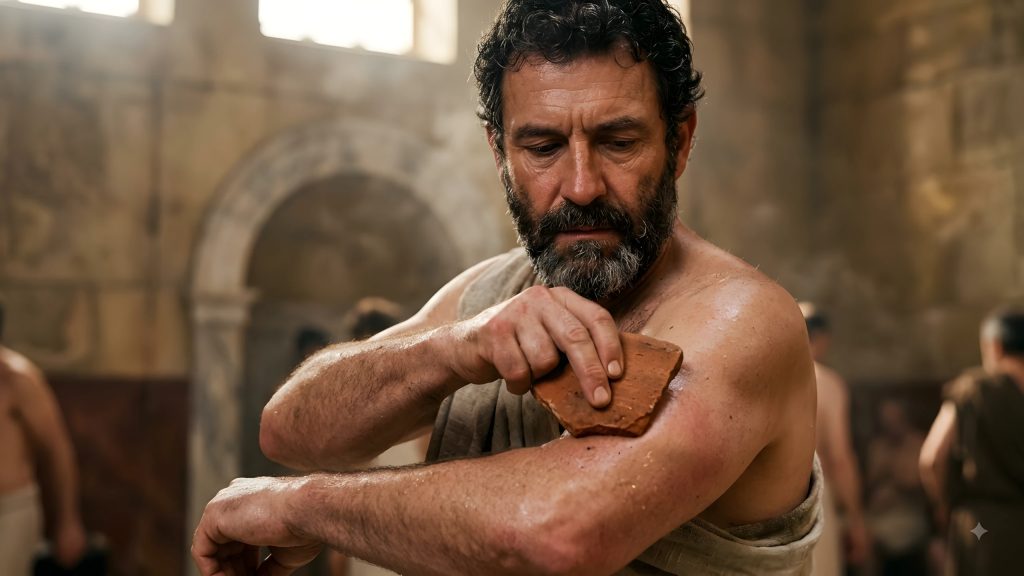
There is an anecdote connected with Hadrian and the custom of bathing, from which is derived the proverbial saying of scraping acquaintance: the Emperor, entering a bath, saw an old soldier scraping himself with a tile. He recognized the man as a former comrade — his memory on such points never failed him — and, pitying his condition that he had nothing better than a tile for a flesh-brush, he ordered the veteran to be presented with a considerable sum of money, and a costly set of bathing garments. Thereupon all the old soldiers of the imperial army became as anxious to claim fellowship with the Emperor as the Kirkpatricks of Great Britain and Ireland are proudly eager to establish kinship with the Empress of the French. As Hadrian entered the bath the day after that on which he had rewarded his former comrade, he observed dozens of old soldiers scraping themselves with tiles. He understood the intent, but wittily evaded it. Scrape one another, gentlemen, said he, you will not scrape acquaintance with me.
Think and Speak
From a ’Fifties Classroom
01
Jigsaw Sentences
based on the passage above
Join each group of ideas into a single sentence, in as many different ways as you can. Change anything you like so long as the ideas remain the same. See if you can use one or more of the words in brackets.
Hadrian saw a former comrade. The man looked poor. Hadrian felt sorry for him.
Army. Sight. Stir.
Trajan allowed men and women to bathe together. Hadrian was the next Emperor. He set separate times for them.
Mixed. Overturn. Succeed.
Clay Lane is based on textbooks written over
seventy years ago, to help us speak with conviction
and courage and not just reproduce the opinions of
others. My word games are intended for
adults who are free from examinations, and can settle
down to the task of developing their talents or of
making good the gaps in their command of English.
There is no examiner here. Take time to observe, to
think, and to use your imagination.
Have something to
say: say it carefully and feelingly. Go ahead.
For the Writer In You
Write Once, Read Once
A passage is not plain English — still less is it good English — if we are obliged to read it twice to find out what it means.
Dorothy L. Sayers, ‘Plain English’, in Unpopular Opinions (1946)